Floor lamps for reading: where the light should land
Shade height, where the lamp stands, how bright the globe should be, and which of our lamps actually light the page: a practical guide to reading by lamplight.

Most floor lamps light a room. A reading lamp has a smaller, stricter job: it lights one page, from the right angle, without putting a bright globe in your eye. Get that right and the armchair becomes the place you actually read, rather than the place you mean to. Get it wrong and you end up squinting beside a lovely lamp that's mostly lighting the wall.
This guide covers what makes a floor lamp good for reading, where it should stand, how bright it needs to be, and how each lamp in our reading floor lamp collection gets its light onto the page. Every one of them was drawn in our Auckland studio and made at our own factory, and we'll be straight about which are proper reading lights and which are softer company for a chapter before bed.
What makes a floor lamp good for reading
Four things separate a reading lamp from a lamp that simply happens to stand beside a chair.
Direction. The light has to travel forward and down onto the page, not up at the ceiling or out through the sides. Open-bottomed domes and drums do this; glowing columns and glass lanterns mostly don't.
Height. The shade's lower edge should sit around seated eye level, so the page is lit and the globe stays hidden.
Reach. The light needs to arrive over the book, which takes an arm, an arc or a tilt that carries the shade out from the pole.
Headroom. The lamp has to take a globe bright enough for the print you read, within the limit on its listing.
By those tests our range sorts into four groups. The Orsay and the Cosmo put light on the page from above, through domes that are open underneath. The Flore and the Marceau give a softer, even reading light through linen drums. The Aurelia reads beautifully for a chapter in the evening, and its own listing is honest that it isn't one for detailed work. And some lamps we love beside a chair are mood lights first: the Rousseau's woven shade gives warmth more than brightness, and the Solara's listing calls it a mood lamp giving off 300 to 500 lumens. They make a reading corner feel inviting. They shouldn't be asked to light the page.
Where the light should come from
Good reading light arrives from beside you and slightly behind, over the shoulder, and lands on the page in front of you. A lamp in front of you puts its glare straight into your eyes. Beside you and slightly behind the shoulder, more of its light lands on the page and the globe stays out of your line of sight.
Height finishes the job. For a lamp that stands beside the chair, the shade's bottom edge belongs at or just below your seated eye level, roughly 105 to 110cm off the floor in most armchairs and sofas, though your own chair decides. Too high and you'll catch the bare globe every time you glance up; too low and the shade lights your lap instead of the book. An arc works differently: its shade hangs above your head and a little forward, so the light falls onto the page from above rather than from the side. Either way, the test takes ten seconds. Sit down with a book and look up. If you can see the globe, the shade is in the wrong place.
Then plan the cord. A reading lamp tends to live in one spot for years, so the base wants the wall side of the chair and the cord wants the skirting, not the walkway. The Orsay, Marceau and Flore all switch at a foot switch on the cable, so the lamp can stand behind the chair and still be switched on with a toe.
A reading lamp is judged on one small patch of paper: light on the page, and none in your eyes.
Arc, offset or gooseneck: three ways to reach the page
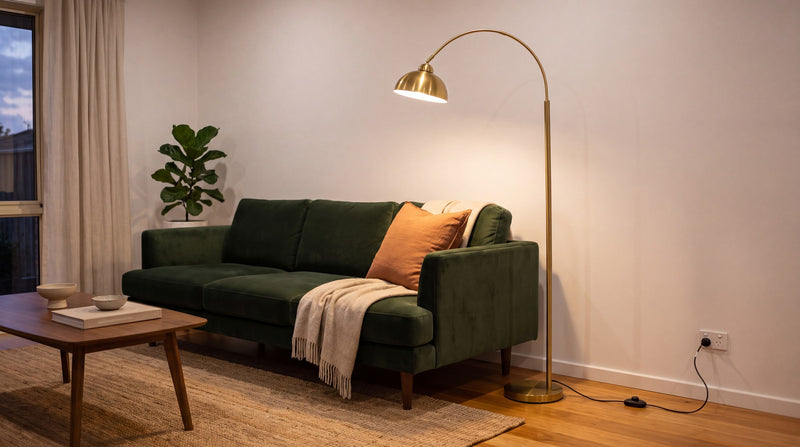
The arc: light from above. An arc stands its base behind or beside the chair and carries the shade out over you, the way a pendant would. The Orsay is the compact version: a slim brushed-gold pole climbs to 173cm and curves about 46cm out, pole centre to shade centre, to hang a 25cm dome over the seat. The dome is open underneath with a white enamel interior, so its light drops onto the book, and it sits on a pivot joint at the end of the arc, so you can tilt it toward the page. It needs about 71.5cm of floor all up. The Cosmo reaches further: 183cm of polished chrome, about 70cm of reach and a 30cm dome that drops its light rather than washing the room, on a 32cm marble base. Its listing asks for about 102.7cm of floor and says its 183cm wants a ceiling nearer 2.7m to feel proportioned. The Flore hangs a 40cm linen drum from the tip of a black arc for a wider, softer pool, lamplight rather than a spotlight. Our arc floor lamp guide covers reach and ceilings in full.
The offset arm: light from beside. The Marceau doesn't arc at all. Its arm leaves the pole, turns once at a right angle and sets a 30cm beige linen drum about 20cm out, enough to lift the light off the pole and nudge it toward the arm of the chair. Linen softens light rather than dropping a hard pool of it, which suits a chair you unwind in more than one you study in, and the whole lamp needs only about 49.3cm of floor.
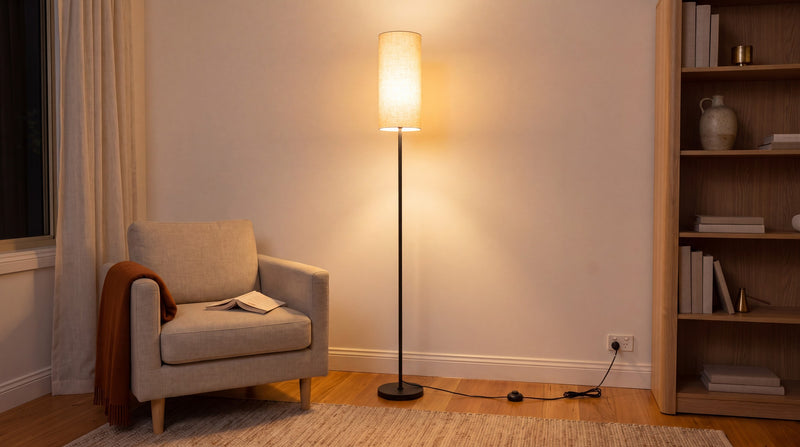
The gooseneck: light by tilt. The Aurelia leans a 34cm cream pleated shade about 16cm out on a brass gooseneck and tilts it, so the glow falls forward onto the book. It works by angle rather than distance, so pull it in close to the chair. The pleats keep the light soft, and its listing is plain that it's an evening lamp rather than a task light: lovely for a chapter, not for fine print.

Reading floor lamps, side by side
Published dimensions from each lamp's listing. Reach is measured pole centre to shade centre.
| Lamp | Size, reach and base | Shade, and how it throws light | What adjusts | Globe limit |
|---|---|---|---|---|
| Orsay | 173cm ~46cm reach ~71.5cm floor 25cm base, 5.6kg |
25cm brushed-gold dome, open beneath, white enamel inside: drops light onto the page | Dome tilts on a pivot joint | 1 × E27, 10W LED |
| Cosmo | 183cm ~70cm reach ~102.7cm floor 32cm marble base, 9.7kg |
30cm polished chrome dome, open beneath: drops light rather than washing the room | Pole height adjusts | 1 × E27, 10W LED |
| Flore | ~195cm reach not published 28cm marble base, ~6.6kg |
40cm white linen drum, 22.5cm deep: a wide, even, softened pool | None listed | 1 × E27, up to 60W |
| Marceau | 163.5cm ~20cm offset ~49.3cm floor 25cm base, 3.1kg |
30 × 18cm beige linen drum: softens rather than drops a hard pool | None listed | 1 × E27, 10W LED |
| Aurelia | 156cm ~16cm lean ~46cm floor 25cm base, 3.7kg |
34cm cream pleated shade, tilted forward: soft evening light, not detailed work | Shade pivots at its joint | 1 × E27, 10W LED |
How bright a reading lamp should be
Brightness comes from the globe, not the lamp, so this part is really about choosing the right one. For a proper reading pool, aim for around 800 lumens of warm white; for a chapter before bed, less is kinder. Lumens are printed on the globe's box, and they're the number worth trusting. A 10W LED globe usually lands somewhere around 800 to 1,000 lumens, but it varies from one make to the next.
Then check the lamp's own limit, because that sets the ceiling on what you can fit. The Orsay, Cosmo, Marceau and Aurelia each list a maximum of 10W LED, which covers a reading pool; the Flore takes a single E27 up to 60W. All five take a standard E27 screw globe, sold separately.
Last, the finish of the globe. The Orsay and Cosmo domes are open underneath, so from a lower seat nearby you can sometimes see up into them; a frosted or opal globe keeps that view soft, where a clear filament would show a hot point of light. Behind linen, as on the Marceau and Flore, a frosted globe keeps the glow even instead of showing a bright spot through the fabric. Our E27 globe guide covers the codes, shapes and wattage limits in detail.
Reading on the sofa, in bed and in a corner chair
On the sofa, the reading lamp belongs at the end you actually read at, base level with the arm and on the wall side. If the middle seat is yours, an arc can hang its shade there instead. Two readers on one sofa are better served by two lamps, one at each end, than by one lamp stretched to cover both.

In bed, the rules shift: the page sits lower, you're propped against a headboard and the shade has to clear a pillow. Our bedroom floor lamp guide covers that geometry, including how to stop a shade glaring from the pillow.
In a corner armchair, footprint decides. The Aurelia needs about 46cm of floor and the Marceau about 49.3cm, so both tuck beside a chair in a tight corner. The Orsay needs about 71.5cm and the Cosmo about 102.7cm, which can be a small corner's whole width. Whatever you choose, leave some other light on in the room. A bright pool in an otherwise dark room tends to tire the eyes as they move between page and room, and a second, softer lamp across the room evens that out.
Choose by sentence
“I read for an hour most nights in the same armchair.” The Orsay: base tucked behind the chair, dome over the page, tilted where you want it.
“I want the light to come from above, like a pendant.” The Cosmo, if you can give it about 103cm of floor and a generous ceiling, or the Flore for a wider, softer linen pool. Its listing gives a 28cm base but no reach or floor width, so measure generously.
“My chair is in a tight corner.” The Marceau or the Aurelia, both under half a metre of floor.
“I read a chapter to wind down.” The Aurelia, warm and soft, exactly as its listing intends.
“I do crosswords, knitting or fine print.” An open dome, the Orsay or the Cosmo, with a globe near its limit and another lamp on across the room. None of the lamps in our Australian range is a clamp-arm task light, so for close work the open domes, which send their light down onto the page, are the ones to reach for.
If you're still choosing a shape at all, start with our floor lamp guide, and when you're ready, the whole group stands together in our reading floor lamp collection.
A few questions, answered
How high should a reading floor lamp be?
The overall number matters less than where the shade ends up. The Aurelia stands 156cm and the Cosmo 183cm, and both are reading lamps: the Aurelia tilts its shade down beside the chair, while the Cosmo spends its extra height on reach, carrying the dome out and over the seat. Judge a lamp by its shade position and reach, not its height. Our height guide covers the maths in full.
Does a reading floor lamp need to be adjustable?
Only if it serves more than one chair or reader; set once in the right spot, a fixed lamp reads perfectly well. Where adjustment helps, the Orsay's dome tilts on its pivot joint, the Cosmo's pole adjusts in height, the Aurelia's shade pivots and the Vienna angles its brass arm over a short arc. Adjustment here means position, not brightness: none of these lamps dims, and each switches at a foot switch on its cable.
Is warm white or cool white better for reading?
For evening reading at home, warm white, around 2700 to 3000K. It sits comfortably with evening light and flatters linen, timber and skin. Cooler, whiter globes suit a home office or a desk you work at during the day; beside an armchair at night they can make a lounge feel like a waiting room. Keep every lamp in the room at the same colour so the pools match.
Can I use a reading floor lamp in a rental?
Yes. All five lamps in our reading collection are 240V, double insulated and plug straight into a standard power point, so there's no hardwiring, no electrician and nothing to ask the landlord. The arcs give you light from above without a ceiling pendant. Just route the cord along the skirting to the power point, rather than across a walkway or under a rug.
Do I need a floor lamp with a separate reading light?
No. Two-headed lamps, a main light plus a small reading arm, suit a room that wants glow and page light from one base, but a single well-aimed shade does the reading job on its own. Our Australian range doesn't include a two-headed lamp, so for both jobs we'd pair a reading lamp by the chair with a softer lamp elsewhere in the room.
Why does my reading lamp cast a shadow on the page?
Usually because of where it stands. Directly behind you, your head blocks the light; on the side you write with, your hand does. Move the lamp beside you and a little behind the shoulder, on the side opposite your writing hand, and lower the shade toward eye level if the light is arriving at a steep angle. With an arc, slide the base until the shade sits just forward of your head.