E27 globes, explained: what to put in your floor lamp
What the codes on the box mean, which globe suits each of our lamps, and why the number on the holder is a heat limit, not a brightness target.

Every floor lamp we make is drawn in our Auckland studio and made at our own factory, and as a rule we leave the globe out of the box. That's deliberate: the globe decides more about the light than the shade does, and we'd rather you chose it than have us guess. It also means someone has to stand in the lighting aisle and decode a box. E27, ES, A60, 2700K, 806 lumens, 8W equals 60W. This is the guide for that moment: what the codes mean, which of them matter for a floor lamp, and the globe we'd fit in each of ours.
What E27 actually means
E27 is a fitting, not a type of light. The E is for Edison screw, the thread you twist a globe into, and the 27 is its diameter in millimetres. Australian packaging often says ES instead, or both; they're the same thing. If the base of the globe is a metal screw thread a little narrower than a 20-cent coin, it's E27.
Three cousins are worth knowing. B22 is the bayonet cap, the push-and-twist fitting with two side pins, still the norm on many Australian ceiling battens. E14 is the small Edison screw, or SES, used in candle-shaped fittings and chandeliers. E26 is the American size, a millimetre narrower; globes sold for that market are usually rated for 120 volts, so if you buy anything imported, check the pack says 220–240V.
Every floor lamp in our range takes E27 and plugs into a standard Australian power point: one holder each on most of them, three on the Voltaire and the Trilogy. Nothing in the range needs an adapter or a special base.
Watts, lumens and the 60W ceiling
Turn a lamp holder over and you'll usually find a marking: E27, max 60W. That figure is a heat limit, not a brightness target. It's the most power the holder and shade are rated to sit next to, written for the old incandescent globe that turned most of its 60 watts into warmth rather than light. Several of ours carry the rating in plain view: the holders on the Aurelia, Rousseau and Solara are marked E27 max 60W in the product photos, and the Camille and Flore listings say the same in words. If a holder shows no marking, look for the rating label on the lamp itself, and when in doubt an LED's single-digit wattage keeps you well clear of any limit.
LED changed the maths. A modern LED that gives the same light as the old 60-watt globe draws around 8 watts, so under a 60W ceiling you're nowhere near the limit and can choose by light output instead. The number to shop by is lumens. Brands vary a little, but the reference figures printed on most boxes line up: roughly 470 lumens stands in for the old 40W, 806 for 60W, 1,055 for 75W and 1,521 for 100W.
How many you want depends on the job. For reading beside the chair, something around 800 lumens under a linen drum gives the page enough to work with. For a lamp that's there to warm the room rather than light it, 300 to 500 lumens is plenty; the Solara's own listing pitches it at exactly that, mood rather than task. If you can still find an old-style incandescent or halogen globe and prefer the look, keep it at or under the marked wattage.
The number on the lamp holder is a heat limit, not a brightness target. A good LED clears it with room to spare.
Warm white, and the number on the box
The colour of white light is measured in kelvin, and the box will tell you. 2700K is the warm white of the old incandescent globe, the one that makes linen glow honey rather than grey. 3000K is a touch crisper and is sometimes also sold as warm white, so read the number, not the words. 4000K is cool white; 5000K and above is daylight. Both belong in the laundry or the garage; in a lounge room at night they make skin look tired and timber look like laminate.
Across our range the advice barely changes. The Marceau and Chandelle listings both call for a warm white frosted globe. The Solara's says 2700K reads most flattering through its fluted glass and daylight globes lose the effect. The Rousseau wants warm white to bring out the tan of its weave, and the Aurelia, Cosmo, Camille and Flore all say warm white too. If there's one number to remember from this guide, it's 2700K. We've written separately about how fabric shades handle light.
One more figure on the box: CRI, or colour rendering index, out of 100. Anything 80 or above is normal; 90 and above renders colours more faithfully, which you notice on a rug or a painting. It usually costs a little more.
Frosted or clear: let the shade decide
The most useful question is whether you'll see the globe. Hidden, its shape is irrelevant and only its colour matters. On show, its shape becomes part of the design.
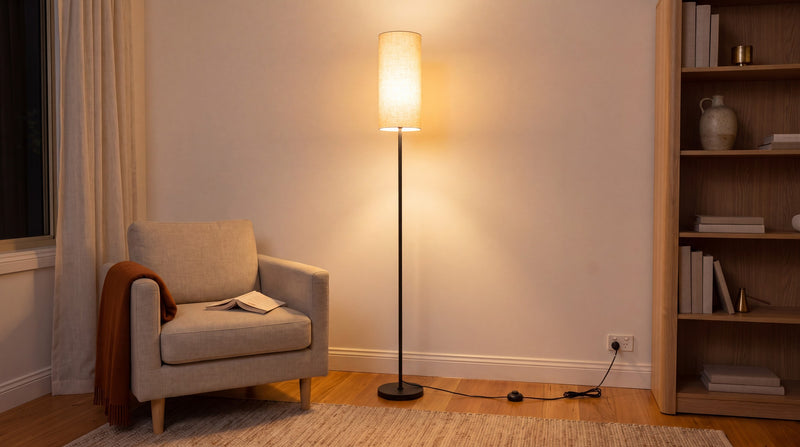
Behind fabric. The Marceau's linen drum, the Chandelle's linen column, the Aurelia's pleated cone, the Rousseau's inner drum, the Flore, the Vienna and the Trilogy's three shades all put fabric between you and the globe. Fit a frosted (opal or pearl) A60. Frosting matters: a clear globe behind linen prints a hot spot in the middle of the shade, while a frosted one spreads the glow evenly to the edges, and since most drums are open underneath, it's the frosting that keeps a glance up from the sofa comfortable. Filament globes are wasted here; nobody will see the coil.

Behind glass. The Solara is the reverse case. Its amber fluted lantern is a lens, not a screen: the listing says a standard A60 disappears behind the flutes while a vintage-style ST64 filament LED becomes the centrepiece, its glowing coil refracting into vertical bands on the wall. The Camille's amber petals look like the same situation but aren't: a white diffuser inside the bloom keeps the bare globe out of view. There, a frosted A60 does the work and the glass does the glowing.

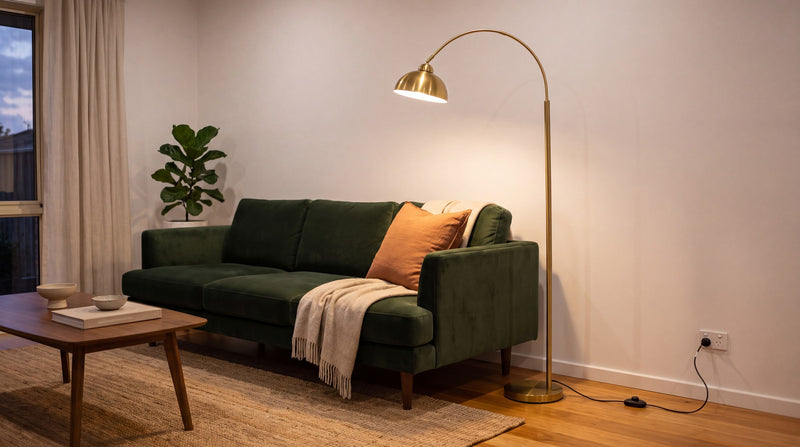
Under an open dome. The Orsay and Cosmo hang metal domes over the seat, open underneath, with white interiors that bounce the light down. From the sofa you'll catch the underside of the globe. For the Cosmo, a frosted A60 keeps the chrome dome calm. For the Orsay, the listing suggests a warm white filament globe to suit the gold, because the dome swallows most of the coil and you mostly see its glow on the white enamel inside.
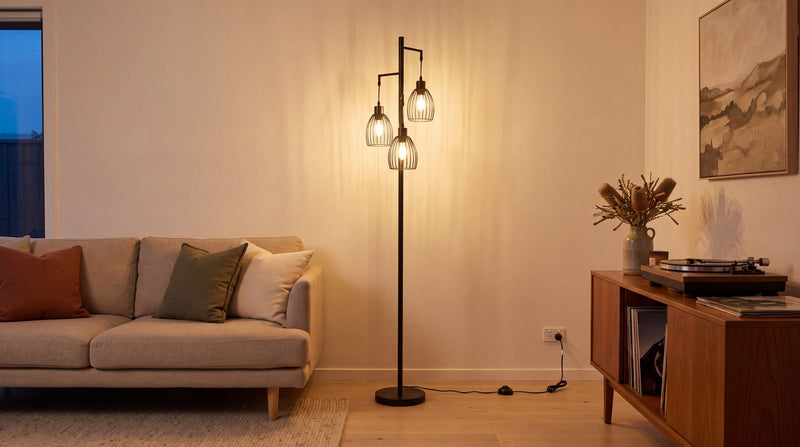
In plain view. The Voltaire hides nothing. Three open wire cages, no fabric, no glass, so the three globes are the entire look. Its listing puts it plainly: ordinary frosted globes will look ordinary, and vintage-style filament LEDs with the visible glowing coil are what the lamp is asking for. Three matching ones from the same pack, since two brands' warm whites can sit a visible shade apart once lit, and on the Voltaire all three light together on one switch.
Shapes that fit, shapes that don't
Globe shapes have codes too, and the code tells you the width in millimetres. A60 is the standard pear-shaped globe, 60mm across, the shape most shades are drawn around and the one to reach for unless the shade tells you otherwise. ST64 is the elongated teardrop Edison shape, 64mm across and taller, the classic filament look. G95 and G125 are the fat round globes, 95mm and 125mm, pendant shapes that are mostly wrong in a floor lamp. R63 and R80 are reflector globes that throw a beam, built for downlights and pointless inside a shade.
This is where the cap and the body part ways. E27 tells you the globe will screw in; only its width and length tell you whether it fits the shade. The Voltaire's cages are 13cm across and 15cm tall with an open bottom. Against those figures an ST64, at 64mm wide, has air around it, anything much over 10cm wide starts to crowd the wires, and a 125mm G125 is nearly the width of the cage itself. The Solara's listing is explicit, A60 disappears and ST64 becomes the centrepiece, so choose between those two. The Chandelle's column is only 16cm wide, so we'd keep to an A60 and leave the linen some air. Bigger shades forgive more; the Marceau's 30cm drum and the Flore's 40cm leave room around either. Most LED packs print length as well as width, and some carry a note about enclosed fittings; if yours does, follow the globe maker's label.
Lamp by lamp: the globe we'd fit
Heights, shades and fittings here come from the live listings, including which lamps show a printed 60W rating; where a marking isn't shown we've listed the fitting only. The picks are ours and follow each listing's own advice where it gives one. Rows are grouped by how much of the globe you'll see. The Camille, Flore, Trilogy and Vienna are on pre-order at the time of writing.
| Lamp | Height | Where the globe sits | Globe | Fitting | Our pick |
|---|---|---|---|---|---|
| Aurelia | 156cm | Cream pleated fabric cone, 34cm | Behind fabric | 1 × E27, max 60W | Frosted A60, warm white LED |
| Chandelle | 166.8cm | Beige linen column, 16cm wide × 40cm tall | Behind fabric | 1 × E27 | Frosted A60, warm white LED |
| Flore | About 195cm at the arc | White linen drum, 40cm × 22.5cm | Behind fabric | 1 × E27, up to 60W | Frosted A60, warm white LED |
| Marceau | 163.5cm | Beige linen drum, 30cm × 18cm | Behind fabric | 1 × E27 | Frosted A60, warm white LED |
| Rousseau | 169cm | Paper-rope weave over a 25cm linen drum | Behind fabric | 1 × E27, max 60W | Frosted A60, warm white LED |
| Trilogy | 195cm | Three oatmeal slub linen shades | Behind fabric | 3 × E27 | Three matching frosted A60, warm white LED |
| Vienna | 168cm | Oatmeal slub linen tapered shade | Behind fabric | 1 × E27 | Frosted A60, warm white LED |
| Camille | 173cm | Amber pressed-glass petals, white diffuser inside | Behind a diffuser | 1 × E27, up to 60W | Frosted A60, warm white LED |
| Cosmo | 183cm | 30cm chrome dome, open underneath | Visible from below | 1 × E27 | Frosted A60, warm white LED |
| Orsay | 173cm | 25cm gold dome, white enamel inside | Visible from below | 1 × E27 | Warm white filament LED |
| Solara | 173cm | Amber fluted glass lantern | Fully on show | 1 × E27, max 60W | ST64 filament LED, 2700K |
| Voltaire | 176.1cm | Three open wire cages, 13cm × 15cm | Fully on show | 3 × E27 | Three matching filament LEDs (ST64 or A60), warm white |
How to choose, in four questions
Four questions, asked in order, settle it.
- Will you see the globe? Behind fabric or a diffuser: frosted A60. On show through glass or in a cage: a filament LED, in the shape you'd like to look at. Under an open dome, either works; we'd go frosted for the Cosmo and filament for the Orsay.
- What's the light for? Reading: around 800 lumens, the 60W equivalent. Warming the room: 300 to 500 lumens, the 40W equivalent or less.
- Which white? 2700K. If the box only says warm white, check the number. If you care how colours read, look for CRI 90.
- Will it fit, and is it under the limit? Check the globe's width and length against the shade, and stay under the holder's marked wattage in actual watts drawn, which an LED does easily. For the Voltaire and Trilogy, count three, matched.
If you'd rather hand one line over the counter, for most of our lamps it's: E27, A60, frosted, 2700K, around 800 lumens (8 to 10 watts), CRI 90 if they have it. Swap the A60 for an ST64 filament where the globe is on show.
Then the small habits. Switch the lamp off at the power point before changing a globe, and let a warm one cool. Screw it in by the base rather than the glass and stop at hand-tight; a globe cranked hard into an E27 holder is the one that later refuses to come out. And keep the box: every code you'll need next time is printed on it.
Read the rest of the lamp with the same care. Height, reach and where the light lands are the other half of the decision, and we've worked through them in our guide to choosing a floor lamp.
A few questions, answered
Is an E27 globe the same as an ES globe?
Yes. ES stands for Edison screw, the family of screw-thread fittings, and E27 is the 27mm size within it: the fitting on every floor lamp we make, and on a great many pendants and table lamps alongside the bayonet B22 that's still common in Australian ceilings. Boxes use either code or both, so look for the number as well as the letters.
Will a B22 bayonet globe fit an E27 lamp?
No. B22 is a push-and-twist fitting with two side pins, and it needs a bayonet holder. Adapters exist that convert one to the other, but they add length inside a shade and are one more thing to fail. Buy E27 for the lamp. If you have spare bayonet globes, they'll be happier in a ceiling batten.
Can I use an LED globe in a lamp marked max 60W?
Yes, and it's the sensible choice. The rating limits the power the globe draws, and a 60W-equivalent LED draws around 8 watts. Even a 100W-equivalent LED, at roughly 13 watts, sits well under the limit while giving noticeably more light. The marking exists for incandescent and halogen globes, which turn most of their wattage into heat.
Do I need a dimmable globe for a floor lamp?
Not for a lamp that switches on and off rather than dims, which is how ours work; the Voltaire's listing says it plainly, all on or all off, no dimmer. A dimmable globe will run happily on a plain switch, it just won't dim. For a softer evening light, choose fewer lumens and 2700K rather than paying for dimming you can't use.
What globe shape fits a floor lamp?
An A60, the standard pear-shaped globe, is the usual answer and our pick for every lamp in the table where the globe sits behind fabric. Where it's on show, an ST64 Edison teardrop is the classic filament choice, and at 64mm wide it has room inside the Voltaire's 13cm cages. Leave G95 and G125 for pendants and skip reflector shapes altogether.
Are globes included with C&F floor lamps?
No, not as a rule, and most of our listings say it in as many words: globe not included. Have them ready before the lamp arrives or it stands there dark on the first night: one frosted warm white A60 LED for most of the range, three matching globes for the Voltaire and Trilogy.