How to choose a floor lamp for an Australian living room
Where the lamp stands, what job its light does, and why a plug beats a pendant: our guide to choosing the floor lamp your evenings settle around.

A floor lamp is the one light in an Australian home you can get completely right without opening a wall. No wiring plan, no ceiling rose, no electrician's invoice. You carry it in, plug it in, and the room changes. It still deserves a little thought, because the lamp you choose decides where the light pools each evening, and that pool quietly becomes the place everyone settles.
Every lamp we sell starts as a drawing in our Auckland studio and is made at our own factory. Choosing well comes down to four questions, asked in order: what job is the light doing, where will the lamp stand, what should it be made of, and what globe finishes it.
Start with the job, not the lamp
Most floor lamps are bought to do one of three jobs, and an honest answer about which one narrows the field faster than an hour of scrolling through floor lamps.
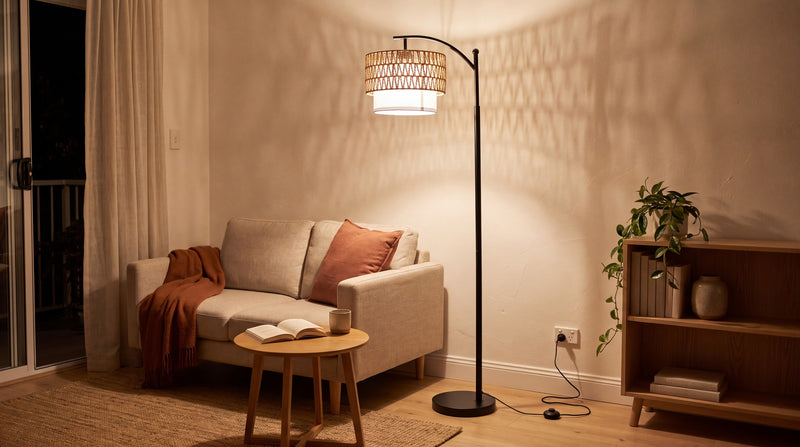
Reading light needs to land on the page, not beside it. That means a lamp that leans, arcs or offsets its shade over the spot where you sit. The Marceau turns its arm at a sharp right angle and sets a beige linen drum about 20cm out from the pole, enough to nudge the light over the arm of a couch. The Aurelia does the same job more softly, its brass gooseneck tilting a cream pleated shade forward so the glow falls onto the book rather than the carpet — though for night-after-night reading, the Marceau's squared-off drum sits more deliberately over the page. The Rousseau splits the difference with a bridge arm that carries its shade about 26cm sideways, enough to clear a slim chair arm and drop light past your shoulder.
Ambience is the opposite brief. You don't want a bright patch; you want the whole room turned a shade warmer, and linen does this gently, letting light out soft in every direction. The Chandelle Linen Column Floor Lamp goes furthest: its entire 40cm linen column glows top to bottom, a single vertical line of warm light against the wall.
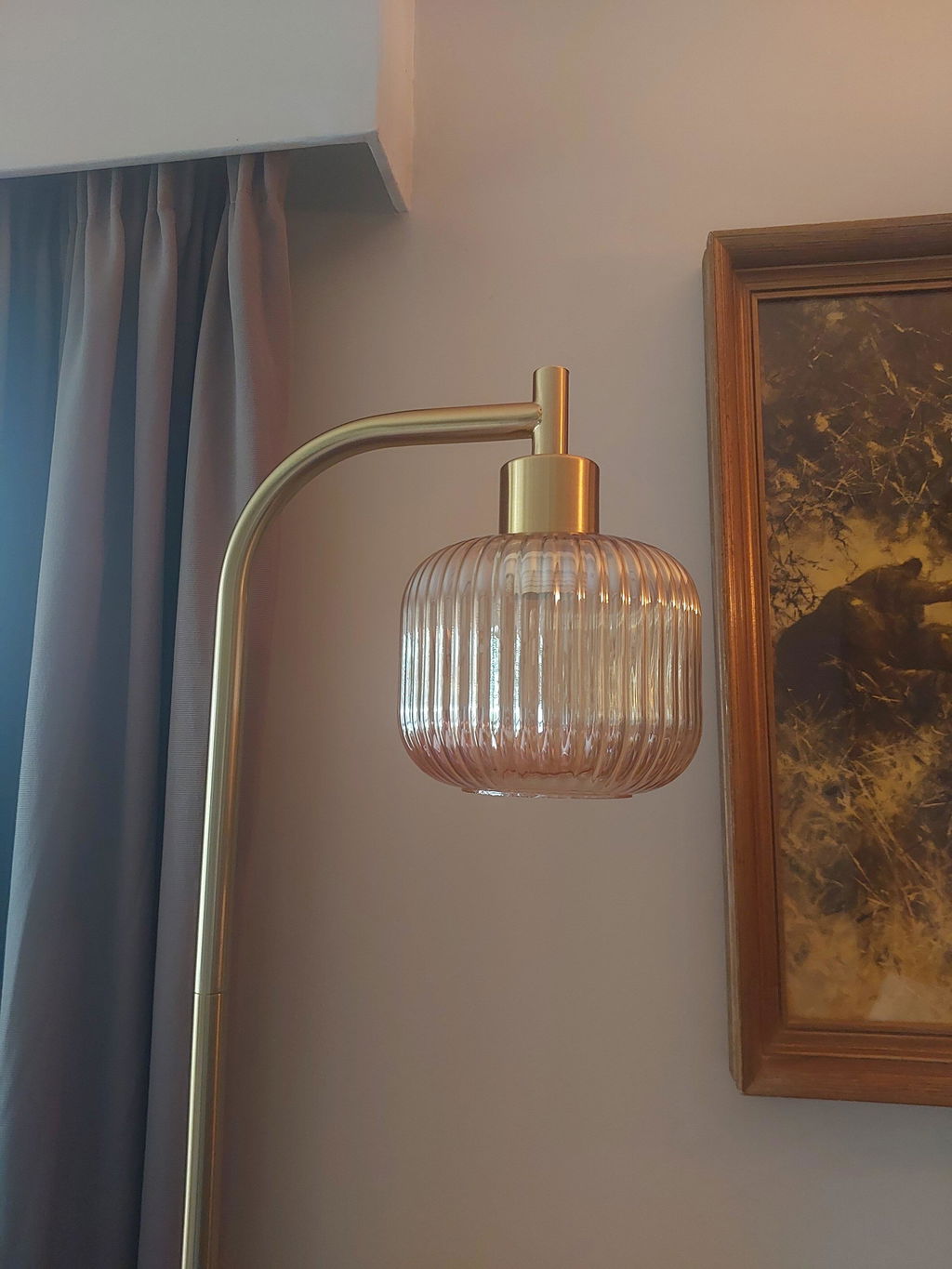
Corner presence is the third job, and the least talked about. Some lamps earn their place by being looked at. The Camille holds pressed amber glass shaped like a lotus in bloom: switched off it reads as sculpture, switched on the whole flower glows. The Solara shows its globe through a fluted glass lantern that breaks light into vertical bands on the wall behind it. Neither is trying to light your book. That's the point.

The lamp you choose decides where the light pools each evening, and that pool quietly becomes the place everyone settles.
Where it stands decides its shape
Now walk the room. The spot you have in mind will rule lamps in or out before taste gets a say.
Over the sofa, an arc floor lamp does the work of a pendant without the wiring. The Orsay Gold Arc Floor Lamp climbs to 173cm, curves out over the cushions and parks a warm gold dome right above your seat. The Flore takes the same idea in matte black, hanging a generous 40cm linen drum from the tip of its arc so the light lands wide and even. We've gone deeper on this whole family in our arc floor lamp guide.
Beside a chair, you want a lamp that keeps its feet close and leans in gently. The Aurelia's cantilever is only about 16cm, so it sits beside the seat rather than reaching across it. The Vienna anchors the same position with a solid white marble base, 6.35kg on its own, and a brass arm you can angle toward or away from the couch.
In the tight spots, footprint is everything. The Chandelle stands on a weighted disc just 20cm across, the smallest in our range, drawn for the gap beside the dresser or the hallway corner that stays dark because nothing else fits. Its foot switch matters more than it sounds: tucked into a corner, you can still tap it on with your toe instead of fishing behind furniture for a cord switch.
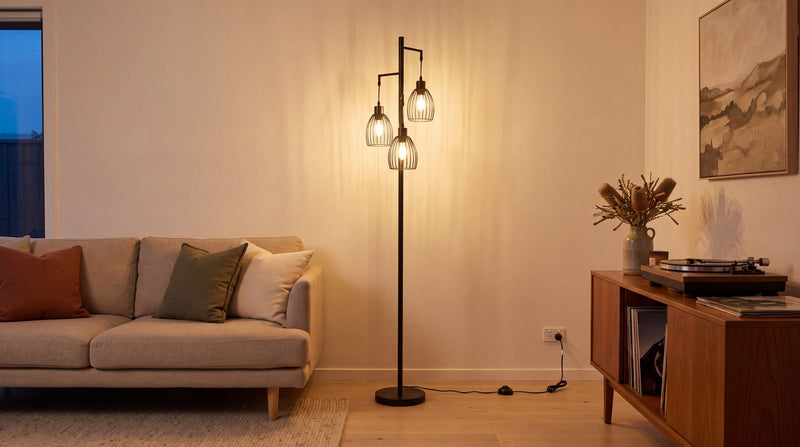
In a genuinely dark corner, one globe only gets you so far. The Voltaire gives you three, each held in an open wire cage and pointed in a different direction, so the corner fills rather than glares.
The numbers that matter
Australian living rooms are more consistent than the furniture in them. Ceilings mostly sit at 2.4m, a sofa back lands around 85cm, and your eye line when seated is roughly 105–110cm off the floor. Those three numbers do most of the choosing for you.
For a lamp beside a seat, you want the bottom edge of the shade at or just below seated eye level, so the shade throws light down onto your lap and the bare globe never sits in your line of sight. That's why most of our range stands between 156cm and 183cm: tall enough to clear the sofa back by a comfortable margin, short enough to leave air between the shade and a 2.4m ceiling. Arcs run taller because the curve needs headroom to sweep; the Flore and Trilogy both reach 195cm at the top of the arc, and the light itself hangs lower, where a pendant would sit.
Glare is a height problem in disguise: if you can see the bare globe from your usual seat, the shade is sitting too high for that spot, which is why shade-bottom-at-eye-line is the rule worth measuring for. Reach is the number people forget. An arc that sails a metre past its base needs that metre of floor plus swing room, while an offset arm of 20–26cm tucks against the furniture. Check the path to the power point too, and plan for the cord to trail along the skirting rather than across a walkway; on lamps like the Marceau and Chandelle an inline foot switch means the switch lives down there with it.
| Lamp | Height | How it places light | Shade | Globe |
|---|---|---|---|---|
| Aurelia | 156cm | Gooseneck tilts forward ~16cm | 34cm cream pleated fabric | 1 × E27 |
| Marceau | 163.5cm | Right-angle arm, ~20cm offset; 25cm disc base | 30 × 18cm beige linen drum | 1 × E27 |
| Chandelle | 166.8cm | Straight column, 20cm base | 40cm glowing linen column | 1 × E27 |
| Vienna | 168cm | Angleable arm over marble base | Oatmeal slub linen taper | 1 × E27 |
| Rousseau | 169cm | Bridge arm, ~26cm sideways | Paper-rope weave over linen | 1 × E27 |
| Orsay | 173cm | Gold arc over the seat | Brushed-gold dome | 1 × E27 |
| Solara | 173cm | Downbridge arm hangs the lantern | Fluted glass, globe visible | 1 × E27 |
| Cosmo | 183cm | Chrome arc over the seat; 32cm marble base | 30cm polished chrome dome | 1 × E27 |
| Flore | 195cm | Full arc, drum hangs pendant-style; 28cm marble base | 40cm white linen drum, 22.5cm deep | 1 × E27, max 60W |
| Trilogy | 195cm | Arc carrying three shades | 3 oatmeal slub linen shades | 3 × E27 |
Materials, and what they do to the light
Two lamps of the same height can light a room completely differently. The difference is what the light passes through on its way out.
Linen softens. Our fabric and linen floor lamps filter the globe through woven fibre, so what reaches the room feels like lamplight rather than a spotlight — the material for the lamp you'll switch on every night. There's a longer story in our guide to fabric floor lamps.
Glass performs. The Solara's fluted lantern turns a plain globe into bands of light across the wall; the Camille's amber petals catch it in their ridges and let it pool in the curves. You choose these when you want the light itself to be decorative.
Weave plays. The Rousseau Rattan Weave Floor Lamp wraps an open zig-zag weave of twisted paper rope around a white linen inner drum, so the weave throws warm pattern onto nearby walls while the linen keeps the light soft and even. If the lounge feels flat, this is texture you can turn on.
Metal sets the temperature of the look. Brushed satin gold, like the Orsay's, lends the glow a softer, warmer cast, so evening light reads gentle rather than showroom bright. Polished chrome does the opposite: the Cosmo's 183cm curve rises from black marble and mirrors the whole room, so it asks for calmer surfaces nearby. Matte black simply recedes, and that's why our black floor lamps suit rooms where the light should be noticed more than the lamp.

Globes: the small decision that finishes the lamp
Every lamp in our range takes standard E27 screw globes, and as a rule the globe is yours to choose — plan on buying it separately. Get this wrong and even the right lamp looks wrong.
The rule that rarely misses: warm white, around 2700K, for anywhere you sit in the evening. It's the colour linen, timber and skin all flatter under. Cooler, bluer globes belong in the laundry and the home office, not beside the couch. Brightness is the other half: around 800 lumens gives a reading pool something to work with, while an ambient lamp can sit well below that — warmth matters more than output once the sun's down.
Then match the globe to how visible it is. Behind linen or pleated fabric, a plain frosted LED disappears and only its warmth matters. But when the globe is on show, its shape becomes part of the design: the Solara's fluted glass wants something worth magnifying, and the Voltaire's three open cages are begging for vintage-style filament LEDs with the visible glowing coil — three matching ones, lined up before it arrives, because the trio switches together on one foot switch. Two carry a ceiling worth knowing: the Flore and Camille each take a single E27 up to 60W.
If you're still stuck, choose by sentence
Find the sentence that sounds like your evenings, and the shortlist writes itself.
“I read every night.” Marceau for a directed pool of light, Aurelia if you'd rather it soft-edged.
“The room just needs to feel warmer.” Chandelle's glowing column, or Marceau doing quiet double duty.
“I want light over the couch and I can't touch the ceiling.” Orsay in gold, Flore in black, Trilogy if one shade isn't enough.
“The corner needs something worth looking at.” Camille's amber bloom or Solara's fluted lantern.
“That corner is genuinely dark.” Voltaire, three globes, three directions.
“There's barely any floor to give.” Chandelle, on the smallest base we make.
Before you buy: the five-point check
Whichever lamp the shortlist lands on, walk the room once more with these five in mind.
- Floor space — measure where the base will sit, and give an arc its full sweep plus a hand's width.
- Height against the seat — shade bottom at or just below seated eye level, roughly 105–110cm.
- The cord's path — lamp to power point along the skirting, never across a walkway.
- Clearance — nobody should brush the shade squeezing past.
- Globes — have the right E27s on hand before it arrives (three matching for the Voltaire or Trilogy), or the lamp stands there dark on night one.
A few questions, answered
How tall should a floor lamp be?
For most Australian living rooms, somewhere between 160cm and 190cm covers it. The Marceau stands 163.5cm, the Orsay 173cm, the Cosmo 183cm, and the Flore and Trilogy top our range at 195cm because an arc needs height to sweep. Beside a seat, aim for the bottom of the shade near seated eye level. We've written a whole guide to floor lamp height if you want the full working.
How far from the sofa should an arc floor lamp stand?
Let the base sit off to the side and let the arc do the travelling — how far to the side depends on the reach of the arc you chose. What matters is where the shade ends up: directly over the seat, high enough to stay out of eye line when you stand. The Cosmo drops its light quite tightly below its dome, while the Flore's wide linen drum lands a broader, softer pool.
Do I need an electrician to install a floor lamp?
No. Every lamp we make plugs into a standard Australian power point, with no hardwiring involved. That's what makes a floor lamp such a good answer in a rental: pendant-style light over the couch without touching the ceiling, and it moves out when you do.
What globes do C&F floor lamps take?
All of our lamps take standard E27 screw globes, and warm-white LED around 2700K is the one we'd reach for in a living space. If you're choosing a design that shows its globe, like the Solara or the Voltaire, pick a decorative filament globe, because the globe becomes part of the look. Plan on buying globes separately.
Are floor lamps safe around kids and pets?
Look for the weight to sit low. Our lamps carry it at floor level — the Vienna's white marble base alone weighs 6.35kg, the Cosmo stands on a 32cm slab of black marble, and the Rousseau carries a counterweight inside its base. A weighted base resists knocks; it doesn't make any floor lamp climb-proof, so treat it as you would other tall furniture. Keep trailing cord along the skirting; on lamps like the Marceau and Chandelle, the inline foot switch means switching happens at floor level, away from the lamp itself.
Can one floor lamp light a whole living room?
Not well, and it shouldn't have to. A living room comes alive with two or three smaller pools of warm light rather than one bright source: a reading lamp doing its job beside the chair, and something ambient like the Chandelle warming the far wall. Layered low light is also simply more flattering than a single lit corner fighting the dark.