Standing lamp, standard lamp, floor lamp: three names for one object
Standing lamp, standard lamp and floor lamp are three names for the same object. Where each word comes from, what floor light, lamp stand and pole lamp mean, and how the black, curved and arc versions measure up.

Ask three Australians what the tall lamp beside the sofa is called and you may get three answers. Nan calls it a standard lamp. The shop calls it a floor lamp. And plenty of us, typing into a search bar at night, call it a standing lamp. All three are right, because all three describe the same object. We draw every one of ours in our Auckland studio and make them at our own factory, and we answer to all three names. This guide sorts out the words: where each one comes from, the smaller ones that orbit them (floor light, lamp stand, pole lamp), and the shape words people add next, like black, curved and arc, with the measurements that sit behind each.
One lamp, three names
Standard lamp is the oldest of the three and the most British. The standard in it has nothing to do with being ordinary. It is the old word for an upright pole or support, the same sense a gardener uses for a standard rose, trained up a single tall stem. A standard lamp is a lamp on a standard. The name is older than the electric globe; Victorian parlours had oil-burning standard lamps on brass poles. Australia inherited the term, and plenty of households still use it.
Floor lamp is the North American name, and it is the one that won the catalogue. Most Australian retailers now file the whole category under it, which is why ours is called the floor lamp collection.
Standing lamp is the plain-English one, a description that became a name: a lamp that stands on the floor, where others sit on furniture or hang from the ceiling. It is common in speech and in search. Going by Google's keyword figures, Australians type floor lamp roughly fourteen times for every standing lamp, and that still leaves thousands of standing lamp searches a month.
So is a standing lamp the same as a floor lamp? Yes, and so is a standard lamp. None of the three implies a different height, fitting, shade or way of plugging in. A shop that lists standing lamps and a shop that lists floor lamps are selling the same thing.
A standard lamp, a standing lamp and a floor lamp are the same object. What changes is who is doing the talking.
The smaller words: floor light, lamp stand, pole lamp
Around the big three sits a ring of near-synonyms, and most of them turn up in our own search data.
Floor light and standing light swap lamp for light and mean the same thing. Floor standing lamp and standing floor lamp say it twice to be safe. Freestanding lamp makes the useful point: nothing is fixed to a wall or ceiling, so the lamp stands on its own base and moves when the furniture does.
Lamp stand, or stand lamp, is looser. Strictly, the stand is the base and pole without the shade, but someone searching for a curved or arched lamp stand wants the whole lamp, and that is how we read it.
Pole lamp has a history of its own. It began as a mid-century American design, a pole braced between floor and ceiling with several adjustable lights along it. These days it mostly means any lamp that is more pole than shade, which makes a slim black pole lamp another way of asking for a straight standing lamp.
Then there is the uplighter, or torchiere: a standing lamp with an upturned bowl that bounces its light off the ceiling. It is a real type of floor lamp, though not one we make. And some people skip the vocabulary and type tall lamp, which is fair. Height has its own section below.
What all the names describe
Whatever you call it, the parts are the same, and they have names too. The base is the weight that keeps the lamp upright, a flat disc on most of ours, from 20cm across on the Chandelle to 32cm of black marble on the Cosmo. The pole, also called the stem or upright, is the standard itself and carries the height. The arm, where there is one, moves the shade away from the pole. The shade shapes the light and gives the lamp most of its character: ours include linen drums, a linen column, metal domes, a pleated cone, a fluted glass lantern and open wire cages. Inside the shade, the lamp holder takes the globe.
Every lamp in this guide is a plug-in: 240V, double insulated, into an ordinary power point with no electrician. The globe is a separate purchase. Both come up again in the questions at the end.
Straight, offset or arc: the words for the shape
Once the name is settled, the next word is usually a shape, and the shape comes down to one measurement: how far the shade sits from the pole.
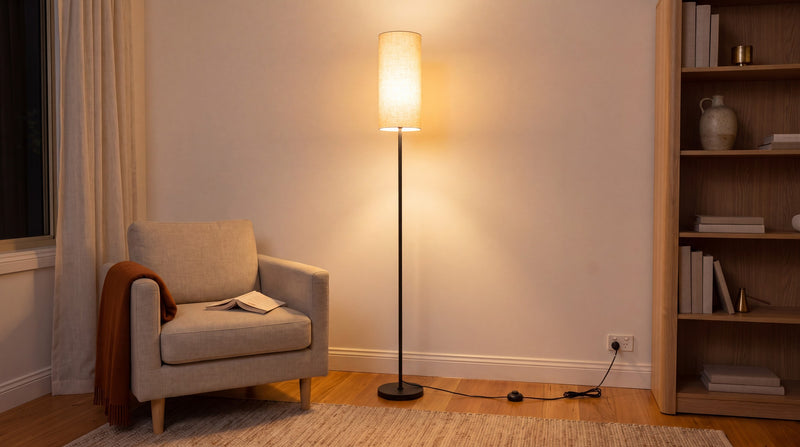
Straight is the classic standard lamp, a pole with the light directly above the base. The Chandelle is the plainest version we make: a 20cm disc, a slim matte black pole and a 40cm linen column, dead straight to 166.8cm. Its listing sums it up as no arc, no spread, nothing to bump in the dark. The Voltaire keeps the single straight pole and puts three short arms near the top, each holding a globe in an open wire cage, 176.1cm tall on a 25.5cm base. As the Aurelia listing puts it, a straight pole floor lamp drops its light in a column beside itself. That is what a corner, a hallway or the gap beside a bookshelf wants.

Offset lamps move the shade a hand's width or so off the pole, so the light lands on the arm of the chair and not the floor beside it. The names describe the arm. A gooseneck curves like one: the Aurelia leans its pleated shade about 16cm out. A right-angle arm turns once, sharply: the Marceau sets its linen drum about 20cm from the pole. A bridge arm arches over and hangs the shade beneath: the Rousseau carries its shade about 26cm sideways, which its listing calls a nudge, not a stretch. The Solara, the nearest thing we make to a standing lantern lamp, hangs its fluted glass lantern from a short arched arm in the same way.
Arc lamps are the long version. The pole itself bends over and carries the shade well clear of the base, about 46cm on the Orsay and about 70cm on the Cosmo. They have their own section below.
The table puts nine of them side by side. Shade offset is each listing's own figure for how far the shade sits from the pole, centre to centre where the listing says so. Width is the listed assembled width; on the Marceau, Rousseau, Orsay and Cosmo the listing defines it as the outer edge of the base to the outer edge of the shade. Every lamp in the table switches at a foot switch on the cable, and none of them dims.
| Lamp | Shape | Shade offset | Height / width |
|---|---|---|---|
| Chandelle | Straight, linen column | None, dead straight | 166.8cm 20cm |
| Voltaire | Straight, three wire cages | Three short arms | 176.1cm 45cm |
| Solara | Hanging glass lantern | Short arm, not listed | 173cm 40cm |
| Aurelia | Gooseneck, pleated shade | About 16cm | 156cm 46cm |
| Marceau | Right-angle arm, linen drum | About 20cm | 163.5cm 49.3cm |
| Rousseau | Bridge arm, woven shade | About 26cm | 169cm 48.6cm |
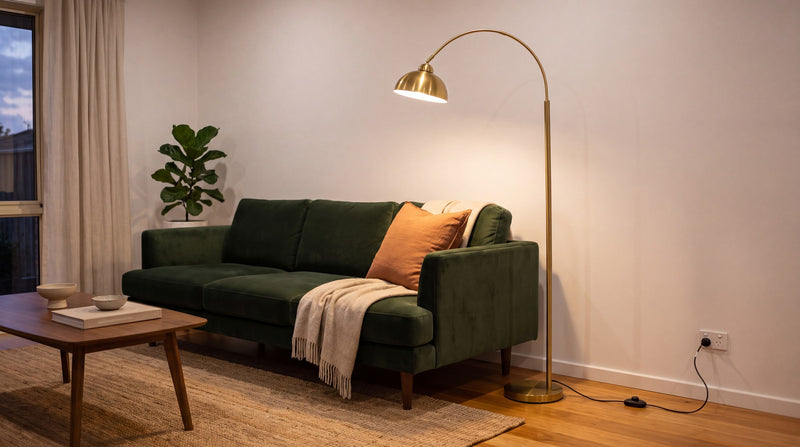
| Orsay | Arc, gold dome | About 46cm | 173cm 71.5cm |
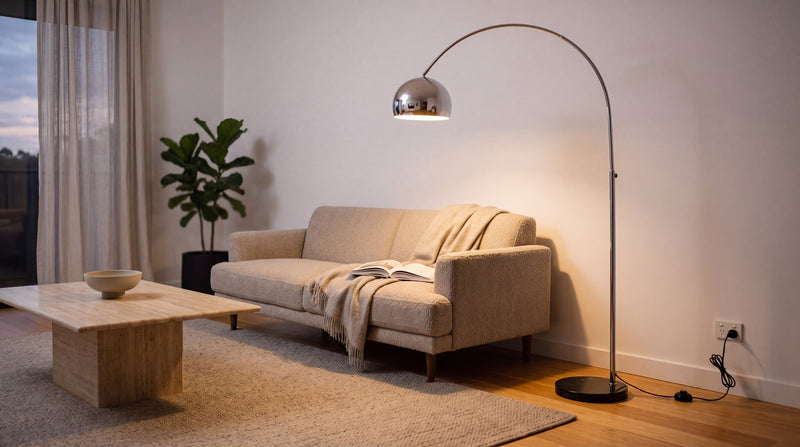
| Cosmo | Arc, chrome dome | About 70cm | 183cm 102.7cm |
| Flore | Arc, linen drum | Not listed | 195.7cm 99cm |
Black, curved and arc standing lamps
People rarely stop at standing lamp. They add a colour or a shape, and the two that turn up most in our own search data are black and curved.
A black standing lamp is the easy one to live with, because a slim black pole reads as a single line and little more. Matte black is the finish on about half our range, more than any other. Among the straight lamps it is the Chandelle and the Voltaire, among the offsets the Marceau and the Rousseau, and among the arcs the Flore, a black arc on a black marble base. Our guide to styling a modern black floor lamp covers what the finish does by day and by night, and the black floor lamp collection has them in one place.
Curved standing lamp, arc standing lamp, arched standing lamp, arc floor light, curved floor light: each is another name for the arc floor lamp, a standing lamp whose pole bends over to hold the shade above the seat, where a pendant would hang. The number that matters is reach. The Orsay reaches about 46cm and takes about 71.5cm of floor from the outer edge of the base to the outer edge of the shade; at 173cm it fits under a standard 2.4m ceiling with room to spare. The Cosmo reaches about 70cm, takes 102.7cm of floor and stands 183cm. Its listing says it wants 2.7m of ceiling to feel proportioned, though it still works under 2.4m with generous furniture below. Our arc floor lamp guide has the tape test for checking reach against your own sofa, and the arc floor lamp collection has the range.

How tall is a standing lamp?
Taller than most people guess, and for a reason: the shade has to clear a seated head, and often a sofa back as well. Ours run from 156cm for the Aurelia to 195.7cm for the Flore, and most sit between about 163cm and 176cm, which leaves comfortable air under a standard 2.4m ceiling. The tall ones are the big arcs, which need the height to carry a shade over the seat. Overall height is only half of it, though. Where the bottom of the shade sits against your eye line matters more. Our guide to how tall a floor lamp should be has every height in one table, and the ceiling maths.
Choose by sentence
If you want the classic standard lamp, a straight pole with the light on top, choose the Chandelle for a tight spot or the Voltaire for a dark corner that needs more than one globe. If you want the light on the arm of the chair, choose an offset: gooseneck, right-angle or bridge. If you want it over the seat, choose an arc and measure the reach first: the Orsay for a smaller room, the Cosmo where there is a clear metre of floor. If the only word you had was black, start with the black collection. And if you are still working out what the lamp is for, our guide to choosing a floor lamp starts one step earlier.
A few questions, answered
Do standing lamps need to be plugged in?
The ones in this guide do. Nothing is hardwired, which is much of the appeal if you rent, but it does mean a cord. Plan its route to the wall before you settle on a spot, and leave the foot switch where a toe can find it. Cord length is not always published; the Marceau listing gives 1.8m. Run the cord along the skirting, out of the walkway and never under a rug.
Are standard lamps old-fashioned?
The name is; the object is not. Standard lamp is what a lot of us heard growing up, usually attached to a fringed shade in a grandparent's lounge room. The type itself, a light at standing height that moves when the furniture does, has never gone away. What dates a lamp is its shade and finish. A linen column, a chrome dome or an open wire cage reads as current, whatever your nan would have called it.
Can one standing lamp light a whole room?
Rarely, and it is not really the job. A standing lamp lights a zone: a chair, a sofa end, a dark corner. The exceptions put several globes on one stand. The Voltaire throws three points of light in three directions, and its listing says it fills the corner where a single shade brightens a patch. For a whole lounge room, plan on two lamps, or three if it is open-plan; our lounge room placement guide covers how many and where.
Which standing lamp is good for reading?
One that puts the light over your shoulder and onto the page. In our range that points to the arcs with open domes, the Orsay and the Cosmo, where the light drops onto what is below. Shaded lamps beside the chair are softer; the Aurelia listing calls it an evening-light lamp, not one for detailed work. Our reading floor lamp guide covers height, reach and how bright the globe should be.
Do standing lamps tip over easily?
The weight sits in the base to resist a knock, though no floor lamp is tip-proof. Across the lamps in this guide, assembled weight runs from 2.5kg for the slim Chandelle to 9.7kg for the Cosmo, whose 32cm marble base counterweights its arc. Any tall, narrow object can still be pulled over, so stand it on a firm, level floor, keep the cord out of the walkway and place it where children and pets cannot climb or tug on it.
What globe does a standing lamp take?
Every lamp in this guide takes an E27 globe, the common large screw fitting; the box will say E27 or ES. Each listing gives 60W as the maximum, which an LED sits far below. Globes are not included, so count before you buy: one for most lamps, three matching ones for the Voltaire. Warm white suits most shades, and our E27 globe guide explains the numbers on the box.