Choosing a bedroom floor lamp: soft light, small footprints
A bedroom lamp gets judged lying down. How much floor you actually need beside the bed, where the light should land once you're propped against the bedhead, and which of our lamps suit the gap.

A lounge room lamp gets judged standing up. A bedroom floor lamp gets judged lying down, at eleven at night, with one arm out from under the doona looking for the switch. Three narrow questions decide it: how much clear floor there really is beside the bed, whether the light lands on the page without landing on the person next to you, and whether you can turn it off without getting up. Below, all three, and which of our floor lamps suit a bedroom once the gap is measured.
What a bedroom lamp has to do that a lounge lamp doesn't
In a lounge room a floor lamp is one light among several, and an odd throw of light gets absorbed by the rest. A bedroom lamp rarely gets that cover. It is usually the last light on and the only one, so it does three jobs alone: enough light to read by, a room dim enough that nobody is jolted awake, and a switch you can reach lying down.
What it replaces is the overhead light, and that is the appeal. A ceiling fitting sits above the bed and throws light down onto faces, the wrong light for the last hour of the day. A floor lamp stands at the side, at roughly the height of a person sitting up, and pushes its light sideways instead.
A bedroom lamp is judged lying down. If you can see the globe from the pillow, either the lamp is in the wrong spot or the shade is the wrong shape.
The rest follows from that. The shade decides whether you cop the globe in the eye, the height decides where its bottom edge sits against your eye line, and the base decides whether the lamp fits at all. Our lamps are drawn in our Auckland studio and made at our own factory, each on a standard E27 globe, not included.
Start with the gap, not the lamp
Bedrooms lose floor faster than any other room. Between the bed, the wardrobe doors and the swing of the bedroom door, the strip beside a bed is narrower than people guess. Three numbers are worth writing down: the clear width between bed and wall, the depth of anything already in that gap, and the distance to the nearest power point.
Then mark it out. Run masking tape on the floor at that width and live with it for a day; it tells you whether that is a lamp-sized gap or a walk-past gap. Match the number against the floor width we publish, measured base edge to shade edge:
- Chandelle, 20cm. A weighted disc about the width of a dinner plate, with nothing above it leaning out.
- Aurelia, about 46cm. The gooseneck sets the width, not the base.
- Rousseau, about 48.6cm. Its arch nudges the shade about 26cm sideways.
- Marceau, about 49.3cm. The right-angle arm sets the drum 20cm clear of the upright.
- Orsay, about 71.5cm. A proper arc, and it needs the floor to prove it.
Then the cord. The lamps we'd put in a bedroom all switch at an inline foot switch on the cable rather than up on the pole, which is a real advantage here: the switch sits within reach of a hand hanging off the side of the bed, and you never reach up into a lit shade. The Marceau has a 1.8m cord, so check the run to the power point before committing to a corner, particularly in the many Australian bedrooms where the only point sits behind the bedhead. Keep the cord clear of the path between bed and door.

Height, and where the light lands when you're lying down
In a lounge room, height is mostly proportion against the sofa back. In a bedroom it is glare, and what matters is not the lamp's overall height but the bottom edge of its shade: the rim you either look down on or up into. If that rim sits above your eye line while you are propped against the bedhead, you see straight up inside the shade at the globe. Level with your eye or below it, the shade does the blocking and you get lit fabric instead.
So take one more measurement, in bed. Sit up the way you would to read and have someone measure from the floor to your eyes. With a mattress top around 55 to 60cm off the floor, most adults land between 110 and 125cm, but treat those as rough figures and use your own; mattress depths vary more than people expect.
Where a shade's rim falls is then subtraction, easiest on a straight lamp. The Chandelle stands 166.8cm with its 40cm linen column at the top of the pole, putting the rim around 127cm, a little above most seated eye lines. On a shade that only lights from below, that would be a problem. It matters less here, because the whole 40cm column lights up top to bottom, so most of what you see is glowing fabric rather than the opening underneath. That is the trade. Either keep the rim at or below your eye, or choose a shade that lights up all over, and check the view from your own pillow before you settle it. Our guide to how tall a floor lamp should be works the same measurement for standing and seated rooms.
Shade shape does the rest. A closed fabric column glows over its whole surface, soft from any angle. A drum that is open underneath, like the Marceau's, lets light out below as well as through the fabric, and the linen softens it rather than dropping a hard pool. An open metal dome like the Orsay's drops its light onto the book or table underneath, its white enamel interior spreading it soft and wide, and it leaves a clear view up into the shade from below. A tilted pleated cone like the Aurelia's aims forward and down, at the page rather than the pillows.
If you share the bed, that geometry also decides which side the lamp goes on. Put it on the reader's side, aim anything tiltable across your own lap rather than down the bed, and lean towards a lined shade, which keeps light in a pool instead of washing the far pillow.
The bedroom shortlist, side by side
| Lamp | Height | Shade | Base and floor width | The light it makes | Where it goes in a bedroom |
|---|---|---|---|---|---|
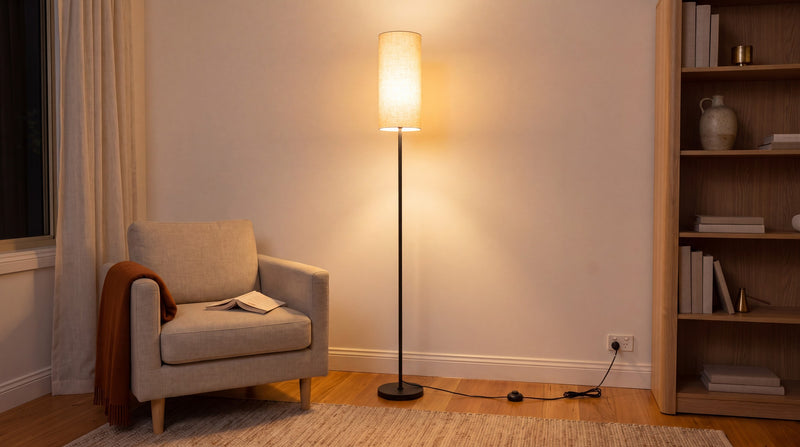
| Chandelle | 166.8cm | Beige linen column, 16cm across, 40cm tall, with bamboo-joint style seams | Weighted disc, 20cm; nothing leans out | A single vertical line of light, glowing top to bottom | The narrow side of a bed, the strip between wardrobe and wall, behind a door |
| Aurelia | 156cm | Cream pleated cone, 34cm across, tilted forward on a brass gooseneck | Round brass, 25cm; about 46cm floor width | Warm and indirect through the pleats, with a faint ribbed pattern on the wall behind | Beside the bed or a bedroom armchair, pulled in close and angled at the page |
| Marceau | 163.5cm | Beige linen drum, 30cm across, 18cm tall, on a right-angle arm | Matte black disc, 25cm; about 49.3cm floor width | Softened light from a drum set 20cm out from the pole | A bedroom corner, or beside a chair where you want glow without the ceiling light |
| Rousseau | 169cm | Tan paper-rope weave, 32cm across, over a 25cm white linen inner drum | Black iron, 25cm, with a 2.5kg counterweight; about 48.6cm floor width | Even light through the linen, warm pattern thrown through the open weave | A bedroom corner with plain plaster walls that needs warmth more than brightness |
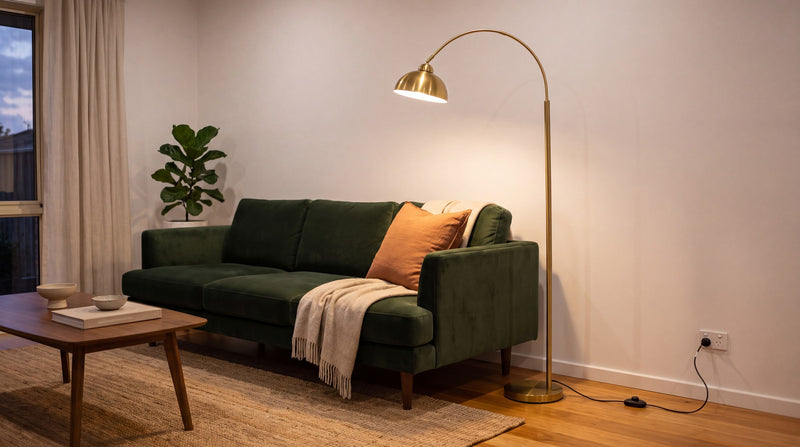
| Orsay | 173cm | Gold metal dome, 25cm across, 11.5cm tall, open underneath | Round gold iron, 25cm; about 71.5cm floor width | Light dropped where the arc puts it, spread soft and wide by the white enamel interior | Behind a bedside corner, leaning light across the end of a bed |
| Solara | 173cm | Fluted glass lantern on a brushed brass stem; the globe is on show | Round brushed brass; 4.8kg, slim footprint | Decorative bands of light on wall and ceiling; roughly 300 to 500 lumens | A bedroom corner as mood light, not a reading lamp |
| Camille (pre-order) | 173cm | Amber pressed-glass petals, about 24.5cm across, white diffuser inside | Round brushed gold; about 40cm footprint | A warm patterned glow, the bare globe kept out of view by the diffuser | A bedside corner where the lamp is meant to be looked at |
| Flore (pre-order) | About 195cm at the top of the arc | White fine linen drum, 40cm across, 22.5cm deep | Black marble, 28cm, with white veining; lamp about 6.6kg | A wide, even pool of light from above, softened through linen | Curving across a bedside corner, in a bedroom with the scale for an arc |
Read it as a spectrum, not a ranking. The Aurelia, Marceau and Orsay aim their light, so they are the ones to read under, and the Flore joins them where a room has the scale for a 195cm arc. The Chandelle and Rousseau sit in the middle: warm, even light for the room rather than a task pool. The Solara and Camille sit at the far end, chosen for the look of the light; the Solara's listing calls it a mood lamp, not a task lamp.

Reading in bed without lighting the whole room
Reading light is a placement problem more than a brightness problem. It wants to arrive from beside and slightly behind your shoulder, land on the page and stop there. Three of our lamps get it there by different means.
The Aurelia uses a gooseneck, and its small 16cm cantilever changes the angle rather than the address: the lamp stands beside the bed and leans its light in. Pull it close, because it works by tilt rather than distance. We drew it for a corner that is lit but not spotlit, and we say so on the listing: not the one for detailed work.
The Marceau gets there with geometry: the arm turns once at ninety degrees and sets its linen drum clear of the upright, near enough to the bed to be useful without leaning over it. The squared-off line suits bedrooms that already have black window frames or straight-edged furniture.
The Orsay is the one that reaches, standing its base clear of the bed and floating the gold dome over the corner of the mattress; leaning light across the end of a bed is one of the three places we list it for. The dome sits on an adjustable joint at the end of the arc, so the angle is yours to set once it is in place. Buy it for the reach, and give it the floor width it needs.
Then the globe, which decides more than the lamp does. Warm white every time in a bedroom, and frosted rather than clear wherever the shade is fabric, so the glow stays even instead of showing a bright spot through the weave. Our E27 globe guide covers the codes and the wattage limits. One honest note: no lamp of ours has a dimmer or a remote, so a lower evening level is chosen at the globe.

The ones we'd leave in the lounge
Not every lamp we make belongs in a bedroom, and our own listings say so first. Two are out on size: the Vienna, 168cm on solid white marble weighing 6.35kg on its own, which we call too heavy for a small studio or bedroom, and the Trilogy, whose arc tops out at 195cm and spreads three linen shades across roughly two metres, not a bedroom lamp unless the bedroom is generous. The Cosmo is a maybe with conditions: 183cm of polished chrome taking 102.7cm of floor width, so not one for a tight corner. Where a modern retro bedroom has the space, keep it the single statement piece and skip the other shiny metal fittings.
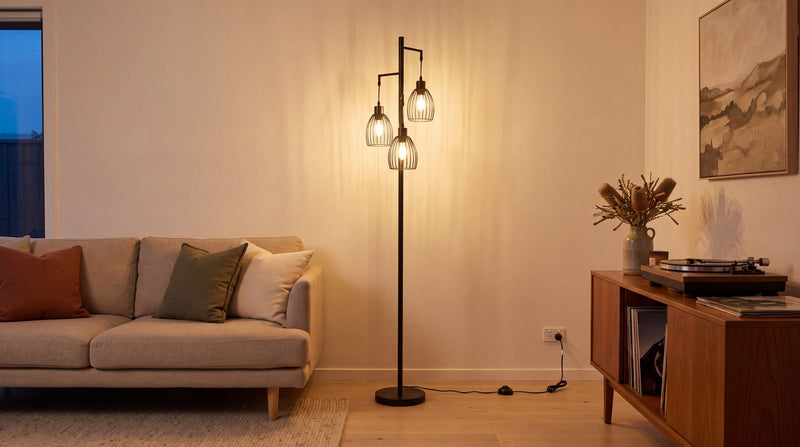
The Voltaire is out on light rather than size. Three exposed globes sit in open wire cages at 176.1cm with no fabric or glass between you and the filament, and they switch together, all on or all off. A good corner-filler for a lounge, a hard light to lie underneath. If black is the finish you want in a bedroom, our piece on styling a black floor lamp covers the pale-shade alternatives.
How to choose between them
Work through these in order and the shortlist usually narrows to one.
- How wide is the clear gap? Under 30cm: the Chandelle, and only the Chandelle. Around 50cm: the Aurelia, Marceau or Rousseau. Over 70cm: the Orsay.
- Do you read in bed? Most nights: the Aurelia for a shade you can aim, or the Orsay for reach. Occasionally: the Marceau or Chandelle. Not at all: the Solara or Camille.
- Where does your eye line sit? Measure it sitting up in bed. If a shade's rim lands above that line, choose one that glows all over, like the Chandelle's column or the Rousseau's lined weave, rather than an open dome you can see up into.
- What does the room have already? Plain plaster that wants warmth: the Rousseau. Black joinery: the Marceau. Timber and brass: the Aurelia. Nothing but a dark gap: the Chandelle.
- One side or both? A floor lamp on one side and something smaller on the other is easier than matching a pair. Keep the globe temperature the same on both sides and the asymmetry reads deliberate.
- Where is the power point? Behind the bedhead: put the lamp on that side, so the cord runs short and the switch lands where your hand does.
Still weighing two of them up? Our full guide to choosing a floor lamp runs through height, spread and placement across the whole range.
A few questions, answered
Can a floor lamp replace a bedside lamp?
In a narrow bedroom it is often the only option, and it works. The Chandelle was drawn for that case: the narrow side of a bed with no room for a table, or the strip between wardrobe and wall. Its base is 20cm across and the pole runs dead straight, so it stands in floor space a bedside table could never use.
How far from the bed should a floor lamp stand?
Close enough that the shade sits over the edge of the mattress rather than out in the room. The Aurelia carries its shade only about 16cm from the pole centre, so it stands almost against the bed. The Orsay reaches about 46cm, so its base sits back and the arc travels. Walkway clearance comes first either way.
What globe should I put in a bedroom floor lamp?
Warm white, and frosted behind fabric. Every one of our floor lamps takes a standard E27 globe and none includes one, so the light is your choice. Warm white keeps the room feeling like evening; cool and daylight globes read clinical after dark. The lamps that show the globe, like the Solara, suit a vintage-style filament shape.
Are your floor lamps dimmable?
No. None has a dimmer or a remote, and the bedroom lamps here all switch on and off at the inline foot switch on the cable. In a bedroom that switch is the useful part, because it sits on the floor within reach of the bed. For a lower evening level, fit a lower-lumen warm white globe and let the shade soften it further.
How do I stop a floor lamp glaring from the pillow?
Get the shade rim at or below your seated eye line, or use a shade you cannot see into. An open dome or drum sitting higher than your eye puts the globe in plain view; a column that lights up over its full height, like the Chandelle's, puts far less of it on show. A frosted globe rather than a clear one helps in every case.
Will a floor lamp be bright enough to read in bed?
That comes down to the globe you fit, how open the shade is and where the lamp stands, more than the lamp itself. The Orsay drops its light onto a book or a table, the Aurelia tilts a softened pool at the page though it is not one for detailed work, and the Flore hangs a wide drum overhead. The Solara is the exception: its listing calls it a mood lamp, roughly 300 to 500 lumens.