Caring for linen and fabric lampshades: dust, marks and the never-soak rule
How to clean a fabric lampshade and keep it clean: the listing's never-soak line and where it stops, the dry-first dusting routine, a damp cloth for marks, and what each of our seven linen, cotton and paper-rope shades asks for, from the Marceau's smooth drum to the Aurelia's pleats.

Switch a fabric floor lamp on after a few weeks away and the first thing you notice is the dust. It settles on the top of a linen drum, in the folds of a pleated shade and on the inside, around the lamp holder, where the glow picks it out. This is our guide to how to clean a fabric lampshade and keep it that way, written for the seven linen, cotton and paper-rope shades in our Australian range. Every one of them carries the same one-line care note on its listing; this is the longer answer. We draw every lamp in our Auckland studio and make them at our own factory; the sizes are the listings' own.
Start with the care line, and where it stops
Every lamp in our floor lamp collection carries the same care instruction on its page: wipe with a soft damp cloth, and do not soak or immerse the product in water or other liquids. Natural fibre takes badly to being wet through: linen slackens and dries with a tide mark, paper rope loses its twist, and a shade that has been soaked rarely sits straight again. The care line draws the one boundary that matters, and nothing in this guide crosses it. The same routine applies whether you call it a lampshade or a lamp shade.
Inside that boundary the order of work is the same for every shade: dry first, damp second, wet never. Dry means a brush, a lint roller or a vacuum on low; damp means a cloth wrung out until barely moist, used on a mark and nowhere else. Everything from here on is our general advice for natural-fibre shades; the listing's line is the limit.
Dry first, damp second, wet never. That is the whole method; the rest is knowing your shade.
Dust first: the routine that does most of the work
Switch the lamp off at the power point, not just the foot switch, and let the globe cool. Then dust from the top down, so dust falls onto the floor rather than onto cloth you have just cleaned. A soft brush is the gentlest tool and works on every shade in the range. On a smooth linen drum a lint roller is faster: a few passes around the outside lift dust, pet hair and fluff. A vacuum with the soft brush head fitted, on its lowest suction and kept moving, suits smooth linen only.
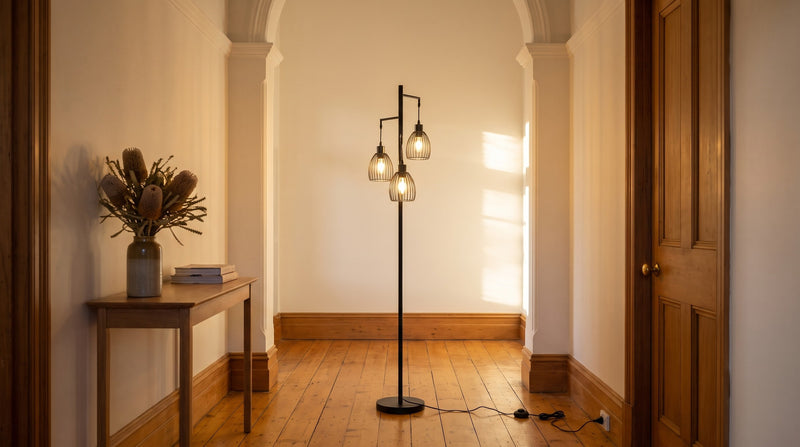
The inside matters as much as the outside. Dust settles on the inner top of a drum and on the lamp holder, and because the globe lights the inside directly, that is the dust you actually see at night. Reach in from below with the brush and work around the holder; on the Chandelle's column, 16cm across and 40cm tall, a long-handled brush gets to the top from either end.
How often depends on the shade and the room. In an ordinary closed room a smooth drum wants a lint roller every two weeks and a brush inside and out each season. A pleated shade wants the brush every week or two, because the folds give dust a hundred small ledges, and so does any shade near an open window, a dog on the couch or an open-plan kitchen. The signal is simple: if the shade looks dull with the lamp on, it is time.

Marks and spots: the damp cloth, used sparingly
A mark on linen is the moment the care line earns its keep. Start dry: brush the area first, since what looks like a mark is often dust pressed into the weave by a hand, and it lifts. If it stays, wet a clean white cloth in plain water and wring it out until it is barely damp. Test on the inside of the shade near the rim first. Then dab the mark from its outer edge inward and stop as soon as its colour starts to move. Rubbing is the mistake: it lifts the surface fibres of the linen and leaves a pale, fuzzy patch that shows more than the mark did. Let the shade dry fully in air before the lamp goes back on.
What not to use is a longer list than what to use. No sprays, no multipurpose cleaners, no glass cleaner, no upholstery foam; they leave rings on natural fibre that never quite leave, as our fabric floor lamp guide says. No detergent, which is next to impossible to rinse out of a shade you are not allowed to rinse. And no bleach on a cream or beige shade, where it leaves a patch paler than the cloth around it. If a mark survives a barely damp cloth, stop there rather than reach for anything wetter or stronger.
Seven fabric shades, one rule
The care line is identical across the range, but the shades are not, and the dry tool changes with the weave. The table is every fabric-shade lamp we sell in Australia, with the shade's size from its listing and the dust tool we suggest for it; sizes are width by height, and the Vienna's tapered shade is 23cm across the top and 30cm at the bottom.
| Lamp | Shade | Size (cm) | Dust it with |
|---|---|---|---|
| Marceau | Beige linen drum | 30 × 18 | Lint roller or brush |
| Chandelle | Beige linen column | 16 × 40 | Lint roller or brush |
| Flore | White fine linen drum | 40 × 22.5 | Lint roller or brush |
| Vienna | Oatmeal slub linen, tapered | 23 to 30 × 22.3 | Soft brush |
| Trilogy | Three oatmeal slub linen drums | 23 × 18 each | Soft brush, three times |
| Aurelia | Cream pleated cotton cone | 34 × 21.5 | Brush along the pleats |
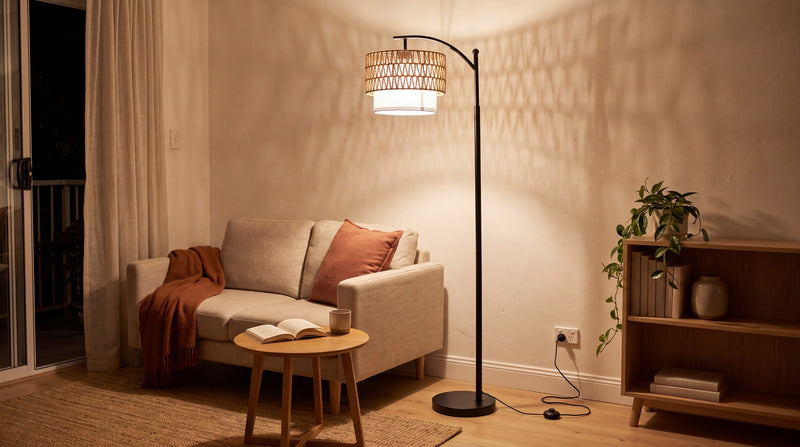
| Rousseau | Paper rope band over a linen drum | 32 × 15 over 25 | Brush only, keep it dry |
Two of them are exceptions. The Rousseau's outer band is twisted paper rope in an open zig-zag weave, and paper and water do not mix, so it is the one shade we keep strictly dry: a soft brush, never a lint roller, which can catch the open cord. Our rattan floor lamp guide has the whole rule. The Aurelia's pleats are the other: brush along the folds from top to bottom, never across them, which crushes the creases; our pleated shade guide covers why the folds collect dust first. The slub linens on the Vienna and the Trilogy can make a small mark less noticeable, because the weave is already uneven, but those raised threads can catch a lint roller, so a brush is the kinder tool. And the Flore's drum is fine white linen, 40cm across, and white linen tends to show a mark readily.
Sun, heat and the globe
Dust is the daily enemy of a fabric shade; sun is the slow one. Natural fibre ages in direct light, and in a room with a north-facing window a cream shade can go a shade warmer on the window side with long exposure while the room side stays as it was. Placement does most of the protecting: a fabric lamp belongs beside the seat, not in the window, and the listings put each one there, the Marceau at the end of a couch, the Aurelia beside an armchair, the Chandelle in the hallway corner. Where a window is unavoidable, turn the lamp a quarter turn once a season so no one side takes all the light.
Heat comes from the globe, and the listing sets the limit: every lamp in the range is marked for a maximum of 60W. A fabric shade sits close to its globe, and the Chandelle's column is only 16cm across, so the cooler the globe runs, the better the shade ages. That is why our pick for every fabric lamp is an LED, which gives the light of the old globes at a fraction of their heat, and our E27 globe guide has the codes and the kelvin numbers. One more reason to stay under the limit: a globe that runs hot bakes dust onto the inside of a shade, and baked dust is a mark, not dust.

Damp rooms, knocks and the shade that arrives flat
Three rooms are off the list for a fabric shade: the bathroom, the laundry and a covered deck. Linen, cotton and paper rope all take up moisture from a humid room, and a shade that never quite dries out grows mildew spots that no damp cloth will shift. In a humid climate, give the lamp a wall with some air moving past it rather than the dead corner behind a door. If a shade does get wet, blot it with a dry cloth straight away, let it dry in moving air rather than on a heater, and leave the lamp off until it is dry through.
Knocks are the other hazard. A dent in a linen drum can usually be eased back gently from the inside with a flat hand, and a crease tends to soften on its own. A badly crushed pleat may not recover cleanly, so the Aurelia is the lamp to park where the vacuum cleaner and the children's feet do not pass. The Flore, Vienna and Trilogy shades arrive flat packed for assembly, and the first clean they get is the one your hands give them, so wash and dry your hands before you fit a white shade: a finger mark pressed in at assembly is one you live with. Moving house, wrap the shade in a clean sheet and put the lamp back in its carton; our guide to floor lamps for apartments and renters has the packing order.
Choose by sentence
If you want the shade that asks least, choose the Marceau: a smooth beige drum that a lint roller keeps clean. The Flore's drum is as easy to dust, but its white fine linen is less forgiving of a mark. If the lamp will live where dust is a fact of life, an open window, a dog, a busy family room, choose oatmeal slub linen, the Vienna or the Trilogy. If you love the pattern a pleated shade throws on the wall and do not mind a brush every week or two, choose the Aurelia. If you want the rattan look, choose the Rousseau and keep it dry. Every one of them is in our fabric and linen floor lamp collection, our fabric floor lamp guide explains what each weave does to the light, and most of them stand on a black frame, which our guide to the modern black floor lamp pairs with rooms. A step earlier, our guide to choosing a floor lamp starts there.
A few questions, answered
Can I wash a linen lampshade?
No, and that includes the gentle versions people ask about: hand-washing in a basin, rinsing under a tap or shower head, a steam cleaner and the delicates cycle. Every listing in our range says wipe with a soft damp cloth and never soak or immerse the product, and all of those soak it. What the cloth gets instead is dry tools, and a barely damp dab on a mark.
Can you vacuum a fabric lampshade?
Yes, on smooth linen, with the soft brush head fitted and the suction on its lowest setting; hold the frame with your other hand and keep the nozzle moving so it never parks on the cloth. Skip it on the Rousseau's open paper-rope weave, which a nozzle can lift, and on the Aurelia's pleats, where a brush along the folds does the better job. That is our general advice for natural-fibre shades.
How do I get pet hair off a fabric lampshade?
A lint roller, on smooth linen, lifts hair in a few light passes; go around the shade rather than up and down so the sheet does not drag the weave. On oatmeal slub linen use a soft brush, since the raised threads can catch the sticky sheet, and on the Rousseau's paper rope use the brush only. A dog on the couch means the lamp beside it collects hair weekly, so roll it when you vacuum the cushions.
My lampshade has gone yellow. Can it be reversed?
Not by cleaning. Yellowing is the fibre itself changing, from sun, globe heat or plain age, and no dry tool or damp cloth brings the colour back; bleach only adds a paler patch. What works is managing it: turn the yellowed side to the wall, fit a warm white LED so the shade reads as cream, and keep the lamp out of the window from now on. A beige or oatmeal shade carries age better than a white one.
My shade has a grey film the brush will not lift. What is it?
Dust that has bonded with something oily: cooking vapour from an open-plan kitchen, candle soot, smoke from a fire or a cigarette. A brush moves over it and a lint roller skates on it. A barely damp cloth, dabbed and not rubbed, lifts some of it; the rest tends to stay, so prevention does the real work. Keep a fabric lamp out of the cooking end of a room and never burn a candle under a shade.
Do I need to take the globe out to clean inside the shade?
Not for dusting. With the lamp off and cool, a soft brush reaches around a fitted globe and over the inner top of the shade without touching it. Take the globe out only if you need to dab a mark on the inner lining, so no moisture goes near the holder, and switch the lamp off at the power point first. Hold the frame, never the cloth, while you work, and let everything dry before the globe goes back in.